LOHASPAIN Highlights the Unique Winegrowing Heritage of Tenerife and Bodegas Viñátigo

The Japanese media outlet LOHASPAIN, which specialises in promoting Spanish wine, gastronomy and culture, has published an article devoted to Tenerife and the distinctive character of its winegrowing landscape.
Under the title “A Cool Island Despite Its Proximity to Africa: Tenerife, Spain’s Unexpected Summer Retreat”, journalist and creative director Ikumi Harada presents the island as a destination that offers nature, gastronomy and pleasant temperatures, even during the hottest months of the year.
The feature focuses particularly on northern Tenerife, where the influence of the trade winds, the proximity of the Atlantic Ocean, the altitude and the volcanic soils shape a territory of extraordinary diversity. It is a landscape where century-old vineyards, native grape varieties and a wine culture deeply connected to the island’s identity continue to thrive.
As part of this journey, LOHASPAIN highlights the work of Bodegas Viñátigo in La Guancha and its commitment to preserving and recovering the traditional grape varieties of the Canary Islands. The article celebrates a journey that began in 1990 and a winemaking philosophy that seeks to convey, with authenticity, the memory of the land, the energy of the volcanic soils and the influence of the Atlantic.
Below, we share the English translation of the article, originally published in Japanese.
A Cool Island Despite Its Proximity to Africa: Tenerife, Spain’s Unexpected Summer Retreat
By Ikumi Harada
8 de julio de 2026
As a result of the heatwaves sweeping across Europe, Spain is also experiencing an exceptionally harsh summer. Temperatures above 30°C and even 40°C are being reported on a daily basis, while wildfires are breaking out in different parts of the country.
It is precisely during such a hot summer that the desire arises to travel somewhere cooler, in search of a pleasant breeze and lush natural surroundings.
When people think of Spanish destinations where they can escape the heat, many imagine San Sebastián in the Basque Country, the Cantabrian coast or the Pyrenees. Asturias and Galicia, blessed by the cool winds of the Atlantic, have also long been popular summer holiday destinations among Spaniards.
However, after discovering the landscapes and characteristics of many regions of Spain through wine, there is one place I would especially like to recommend as a destination for this summer.
“That place is the island of Tenerife, in the Canary archipelago.”
Because of its proximity to the African continent, Tenerife may give the impression of being a very hot island. In reality, however, its summer climate is quite different. Particularly in the north of the island, even at the height of summer, pleasant days with temperatures between 20°C and 25°C are common. The cool breeze from the Atlantic makes for a very comfortable stay.
Its climate offers a pleasant freshness similar to that found in the traditional summer retreats of northern mainland Spain. The striking natural scenery of a volcanic island, together with the wide variety of environments created by changes in altitude, shapes Tenerife’s unique summer appeal.
Comparison of maximum temperatures on 8 July 2026: Galicia, 31°C; San Sebastián, 26°C; Bordeaux, 35°C; Burgundy, 31°C; Tenerife, 24°C.

The Terroir of Northern Tenerife, Shaped by the Volcano and the Atlantic
Tenerife is approximately a three-hour flight from Madrid and between three hours and thirty minutes and three hours and forty-five minutes from Barcelona.
Located in the Atlantic Ocean, around 300 kilometres off the western coast of Morocco, Tenerife enjoys a mild climate that has earned it the nickname “the island of eternal spring”.
This climate is shaped by the Canary Current, which flows through the Atlantic Ocean; the trade winds, which blow from the north-east; and the geographical diversity created by Mount Teide, which rises to 3,718 metres above sea level.
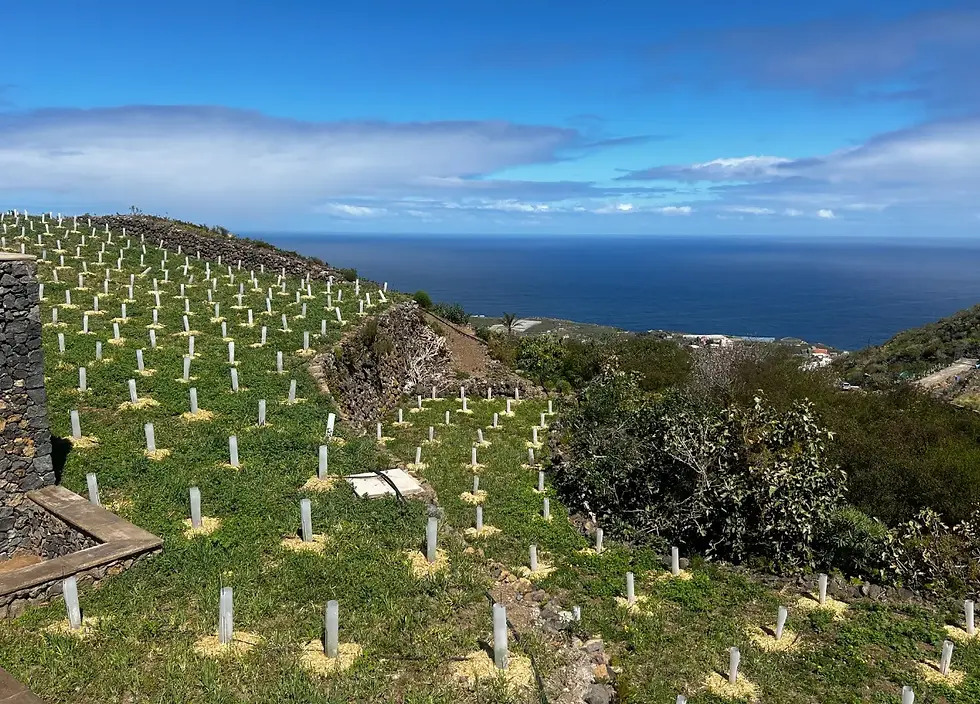
Within the island, the north is an especially appealing area for wine lovers.
The humid air carried by the trade winds and the mineral-rich soils formed through volcanic activity create an exceptional terroir. These conditions make it possible to produce wines of great character that are unique to the Canary Islands.
The black volcanic earth, ungrafted vines more than one hundred years old and the cool breeze arriving from the Atlantic combine to create an extraordinary landscape.
Walking through the vineyards in the middle of summer, breathing in the pleasant, fresh air and tasting the wines alongside the local cuisine is a special experience that can only be enjoyed in Tenerife.
A summer retreat is not simply a place where temperatures are lower. It is also a place where visitors can comfortably surrender themselves to the landscape, the local food culture and the natural environment.
In northern Tenerife, summer days with temperatures of around 25°C are common, and time passes with the calm serenity of a spring day.
For people from northern Europe, who face particularly harsh winters, the Canary Islands have long been loved as an “Atlantic paradise” to which they travel in search of sunshine and mild temperatures.
Now, Tenerife is also revealing a new appeal as a destination where travellers can escape the summer heat and take their time enjoying wine, gastronomy and nature.

A Winery to Visit in Tenerife: Viñátigo
When speaking about the wine culture of northern Tenerife, it is impossible not to mention Viñátigo, a winery located in the municipality of La Guancha.
Founded in 1990 by Juan Jesús Méndez, heir to Tenerife’s winegrowing tradition, Viñátigo is one of the producers that has led the preservation and recovery of the native grape varieties passed down from generation to generation in the Canary Islands.
As the Canary Islands remained free from the phylloxera plague, exceptional vines growing on their own roots can still be found throughout the archipelago.
Viñátigo produces wines that express the terroir of Tenerife, bringing out the personality of varieties deeply rooted in the land, such as Listán Blanco, Marmajuelo, Gual, Vijariego Blanco and Baboso Negro.
The soils of a volcanic island, the humid winds blowing in from the Atlantic and vineyards located at different altitudes create a privileged environment.
These conditions give the wines vibrant acidity, abundant aromas, a mineral quality reminiscent of salinity and a complex, lingering finish.
In a glass of wine enjoyed in a cool climate that makes you forget the heat, you can sense the Atlantic breeze, the volcanic land and the history passed down from generation to generation on the island.
A visit to Viñátigo is not simply about tasting wine. It is an opportunity to discover the passion of a producer working to preserve for the future grape varieties that were once close to disappearing, and to experience, through a single bottle, the memory of an island such as Tenerife.
Original article published by LohaSpain (leer)
Ikumi Harada
Journalist and Creative Director
Ikumi Harada is a journalist specialising in Spanish wine and gastronomy.
She developed her professional experience as a designer at an advertising agency, where she acquired a creative perspective and a strategic way of thinking.
During a period of study in Spain in 2005, she became fascinated by the country’s wine and food culture. Since then, she has devoted herself to researching and promoting both fields.
Since 2009, she has worked in the export and promotion of Spanish wines in the Japanese and Asian markets. In 2011, she founded the Spanish Wine and Food Association, through which she works to promote greater understanding and contribute to the development of the market.
Since 2012, she has been involved in winemaking in Priorat and, in 2024, released her first vintage under her own name.
Since 2025, she has been part of the organising team of the Barcelona Wine Test, an international wine competition held in Barcelona.
She holds the WSET® Level 3 qualification and is certified as a Spanish Wine Specialist by ICEX.
She is originally from Yamaguchi Prefecture, Japan.


Comments