Food & Wine en Español spotlights Bodegas Viñátigo and the volcanic identity of the Canary Islands
The Autumn 2026 issue traces Juan Jesús Méndez’s journey, the viticultural heritage preserved in the Canary Islands and the international expansion of Viñátigo wines, now available in Mexico

The Autumn 2026 issue of Food & Wine en Español turns its attention to the Canary Islands and finds in Bodegas Viñátigo one of the keys to understanding why the archipelago holds such a singular place on the world wine map.
Under the title “D.O.P. Islas Canarias: Lava, Sea and Science”, journalist Nayeli Estrada has written an in-depth feature, accompanied by photographs by Juan Pablo Espinosa, tracing the origins, development and scope of the work carried out by Juan Jesús Méndez over several decades. It is a journey closely linked to the recovery of indigenous Canary Islands grape varieties, the scientific study of the vineyard and the defence of a form of viticulture capable of expressing the identity of each place.
Being featured in Food & Wine en Español is especially significant given the publication’s prestige and influence. Founded in 1978, Food & Wine has become one of the world’s leading international publications devoted to gastronomy, wine and culinary travel. Its Spanish-language edition, launched in Mexico and now also present in Spain, connects these stories with a community of readers particularly interested in origin, authenticity and new expressions of wine.
The feature goes beyond presenting a winery or a selection of labels. It builds a narrative that brings past and future together: from the varieties introduced to the Canary Islands between the 15th and 18th centuries that survived phylloxera, to the molecular identification of their genetic heritage, the study of their aromatic profiles and the use of artificial intelligence to address the challenges facing the vineyard.
In its pages, Bodegas Viñátigo director Juan Jesús Méndez explains how the knowledge acquired during his studies in Chemistry enabled him to transform the small family winery and contribute to a new understanding of winegrowing in the Canary Islands. Tradition, research and territory emerge as inseparable parts of a single vision.
Mexico, a new destination for Viñátigo wines
The publication also comes at a particularly significant moment for the international reach of our wines. In its presentation of the Autumn 2026 issue, the magazine itself identifies “the arrival of Canary Islands wines in Mexico” as one of the stories completing its editorial journey.
Mexico is a market of considerable interest for Spanish wine. The Economic and Commercial Office of the Spanish Embassy in Mexico City defines it as the leading destination for Spanish wine exports in Latin America and a strategic gateway for brands seeking to grow throughout the region.
For Viñátigo, this expansion is not driven by a strategy of volume, but by selective internationalisation. It is about reaching markets, restaurants, distributors and consumers capable of understanding the value of limited-production wines from singular vineyards, made with grape varieties found nowhere else in the world.
That journey began years ago at some of the most influential tables in international gastronomy. The feature recalls the role played by restaurants such as ElBulli, El Celler de Can Roca and DiverXO in introducing Canary Islands wines to a wider audience and opening up new commercial opportunities beyond the islands.
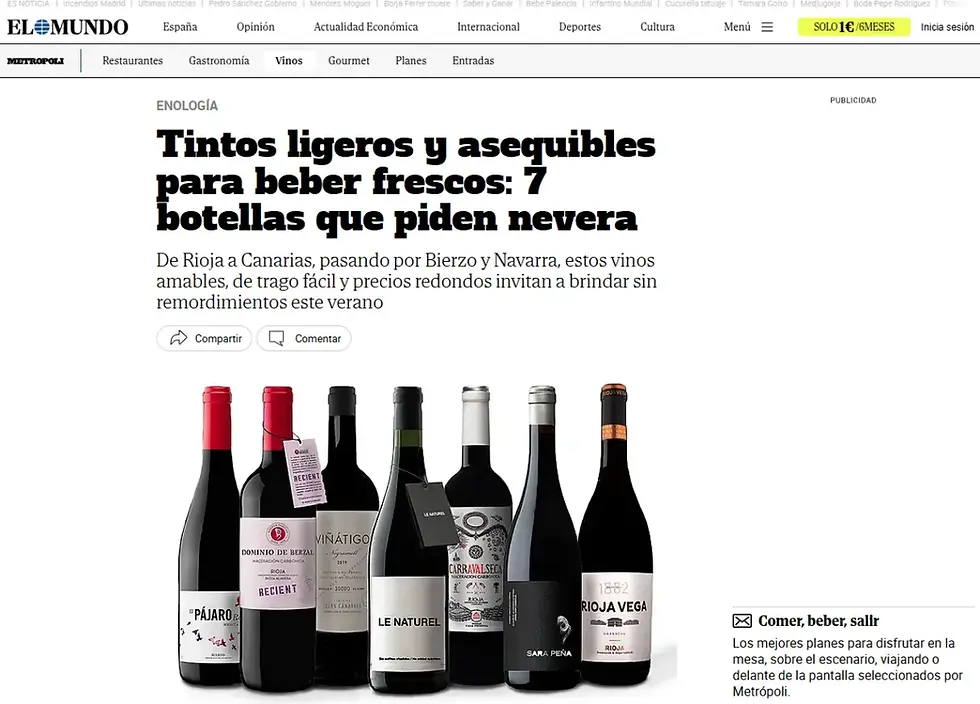
Mexico now represents a new chapter in that journey. The magazine not only places the history and work of Viñátigo in context, but also introduces Mexican readers to four of our wines — Viñátigo Ensamblaje Blanco, Viñátigo Ensamblaje Tinto, Viñátigo Elaboración Ancestral and Viñátigo Listán Negro — and provides information about their availability and prices in the country.
The inclusion of these wines in the “Wines of Volcanic Expression” section turns editorial recognition into a tangible opportunity to discover and taste our wines. The Canary Islands cease to be merely a distant and fascinating place and become a wine origin that can already be found and enjoyed in Mexico.
Below, we reproduce in full the feature published in the Autumn 2026 issue of Food & Wine en Español.
D.O.P. Islas Canarias
Lava, Sea and Science
By Nayeli Estrada
Photography by Juan Pablo Espinosa
Winegrowing in the Canary Islands is rooted in volcanic soils shaped by violent eruptions in the Atlantic Ocean more than 20 million years ago, and in a genetic heritage that escaped the shroud of oblivion spread across Europe by phylloxera during the 19th century.
The region became a repository from the very beginning of its winegrowing tradition, established by Italian, Spanish, French and Portuguese travellers who found in its terrain and diversity of climates fertile land for the vines that accompanied them on their journey.
“From the 15th to the 18th centuries, the only route to America ran through the islands. That was the golden age of our wines: we became the world’s largest producer and exporter of a wine known as Canary Wine,” explains Juan Jesús Méndez, founder of Bodegas Viñátigo and president of the D.O.P. Islas Canarias.
Following the spread of phylloxera, which forced the uprooting of vast areas of vineyards across Europe during the 19th century, many grape varieties disappeared. Untouched by the catastrophe, those vines survived in the Canary Islands, turning their vineyards into a historic archive.
“Tenerife is an island of around 2,000 square kilometres, an area similar to the Mexico City metropolitan area. Through molecular genetic identification, we were able to recognise 82 varieties, more than half of which exist only in the Canary Islands. This is the ‘Jurassic Park’ of world viticulture,” Juan Jesús says.
La identidad como punto de partida
The botanical heritage safeguarded by the Canary Islands is founded on resilience and research. The architect behind these principles is Juan Jesús Méndez, who has played a decisive role in understanding and projecting the identity of the region’s terroirs.
“For as long as I can remember, I have had a connection with wine. I worked in the vineyard and winery with my parents and grandparents. We made wine in a very traditional way in the north of Tenerife, always using indigenous grapes, and sold it in the village shops,” he recalls.
His studies in Chemistry appeared to be taking him away from the small family winery, which produced barely 8,000 litres a year. Over time, however, he discovered that this knowledge could be applied directly to the vineyard.
“I was fortunate enough to attend university, a privilege my ancestors did not have, and over time I realised what I could contribute to the family business,” he recalls.
By bringing together the Canary Islands’ winegrowing tradition and scientific knowledge, Juan Jesús transformed his family’s winery and the viticulture of the archipelago.
Research and territory
Exploring the landscape of his childhood led him to focus his research on local grape varieties.
“My ancestors harvested both white and red grapes and made a rosé wine without any further complications. But when I began studying the grapes, I realised that we had an extraordinarily complex heritage and that most of the varieties were unknown to many winegrowers.”
His search for answers led him to the Galicia Viticulture and Oenology Station, a region with experience in recovering indigenous grape varieties. On that Atlantic coast, he met Elena Batista, a researcher who shared his passion for the land.
“Looking for regions that had faced situations similar to ours took me to Galicia, historically the most isolated part of Spain and a region specialising in minority grape varieties.”
During the 1980s, when the world favoured grapes such as Chardonnay and Cabernet Sauvignon, Juan Jesús and Elena began identifying the region’s winegrowing heritage. The two scientists later became involved with the Department of Molecular Biology at Universitat Rovira i Virgili in Tarragona to identify the DNA of the vines in 2000.
“At that time, even the public authorities suggested that we should forget about minority grapes and play it safe with varieties such as Cabernet and Merlot. We firmly refused because we believed that, by losing our grapes, we would also lose our identity.”
Following the genetic profiling, the scientists turned to laboratory research to determine the organoleptic expression of their wines.
“In 2007, in collaboration with the University of Zaragoza, we established the aromatic descriptors of the grape varieties of the Canary Islands. We used their electronic nose to identify the aromatic compounds of each variety at a molecular level, applying scientific rigour to a sector that had previously been highly empirical.”
“WE WENT FROM HAVING NO GRAPES BEFORE COLONISATION TO SAFEGUARDING MANY VARIETIES THAT CAN NO LONGER BE FOUND ANYWHERE ELSE IN THE WORLD, BECOMING A RESERVOIR OF THE VITICULTURAL IDENTITY THAT EXISTED IN EUROPE MORE THAN 500 YEARS AGO.”
The strategies now guiding viticultural decisions in the Canary Islands are based on artificial intelligence, drawing on more than 25 years of digitisation, hyperspectral satellite imagery and digital monitoring of individual vineyard plots.
“Technology is not synonymous with interfering with nature; quite the opposite. Without AI, we will not be able to respond to the major challenges facing the world, essentially because it enables us to take preventive action,” emphasises the director of the P.D.O.
The origin of a designation
In 1980, the region began consolidating local Designations of Origin whose names were determined by the original towns in each area. According to Juan Jesús, these names were particularly cumbersome for commercial purposes.
“In 2011, we promoted the creation of the Islas Canarias Protected Designation of Origin, which we linked to the Canary Wine collective brand. We are the only PDO to combine administrative protection with a collective brand, making us pioneers once again.”
For Elena Batista, the challenges have not disappeared. The principal one is preventing the abandonment of agriculture as a result of economic, social and climatic factors.
“Leading this revolution has presented many challenges. We are now working to raise awareness of the need to move towards sustainable cultivation with the support of artificial intelligence. I want people visiting the Canary Islands to find a green island, with vineyards, banana plantations and tropical crops. That must not be allowed to disappear.”
A culinary odyssey
The singularity of their terroirs has taken them to the world’s culinary capitals, carrying the volcanic character of their vineyards into the glasses of restaurants such as El Celler de Can Roca, ElBulli and DiverXO.
Researching Baboso Negro and serving it at El Celler de Can Roca marked a major change for the Canary Islands. ElBulli was the first major restaurant to open its doors to these wines, and their inclusion on fine-dining wine lists helped the region secure importers.
“Mexico is of great interest to us because it is undergoing an important gastronomic revolution.”
Despite their international presence, around 80 percent of the wines remain in the local market.
“We account for 0.6 percent of Spain’s one million hectares of vineyards, and we consume most of our wines locally and to cater for the 18 million tourists we welcome each year.”
According to the researcher, the islands’ winegrowing model is based on small-scale production: 7,000 hectares shared among 8,000 winegrowers and 300 wineries.

Wines of Volcanic Expression
Viñátigo Ensamblaje Blanco
Two months separate the harvesting and vinification of the grapes. Once each variety reaches its peak during ageing, they are blended into this wine to express the best of each one. The nose reveals aromas of tropical fruit, honeysuckle, apricot and mint. On the palate, it offers deep flavour underpinned by Tenerife’s characteristic smoky note.
Viñátigo Ensamblaje Tinto
A blend of red grape varieties from the Canary Islands, grown in northern Tenerife, harvested and vinified separately. The nose reveals notes of damp earth, pepper, black fruit and mushrooms. The palate is fresh, with flashes of spice.
Viñátigo Elaboración Ancestral
This orange wine is made from the Gual variety, fermented on its skins and aged for nine months. The nose reveals aromas of rosemary, bay leaf and incense. It is powerful on the palate, with a long finish.
Viñátigo Listán Negro
To make this wine, grapes from organically farmed vines more than 100 years old are harvested by hand. The nose reveals notes of black fruit and a touch of smoky minerality. Blackberry flavours stand out on the palate, accompanied by fresh acidity.
Originally published in Food & Wine en Español, Autumn 2026 issue, pages 155–157.
Visit the Food & Wine en Español website | View the presentation of the Autumn 2026 issue


Comments